
Respite for Family Carers
Space that does family carers good.
Regular support creates time for work, children, appointments, rest or simply an hour for yourself – organised by someone you can trust.

Overview
Who is respite care for?
Anyone who regularly looks after a relative often organises a second everyday life on the side: appointments, phone calls, visits, small and large tasks that hardly fit in between work and their own life. This service is for family carers who would like reliable cover – not as one-off help, but as a fixed, recurring part of everyday life.
The focus is not on the individual task, but on what actually creates free time: a fixed afternoon for appointments, an evening for yourself, or knowing that someone reliable is there.
Being there for others without losing yourself – regular cover makes exactly that possible.
What respite care can include
- A fixed, recurring cover time the family can plan around
- Taking over accompaniment, company or selected tasks during this time
- Short-notice cover for individual appointments, capacity permitting
- An open conversation about what really takes the pressure off family carers in everyday life
- Coordination with existing support services, such as nursing services or day care
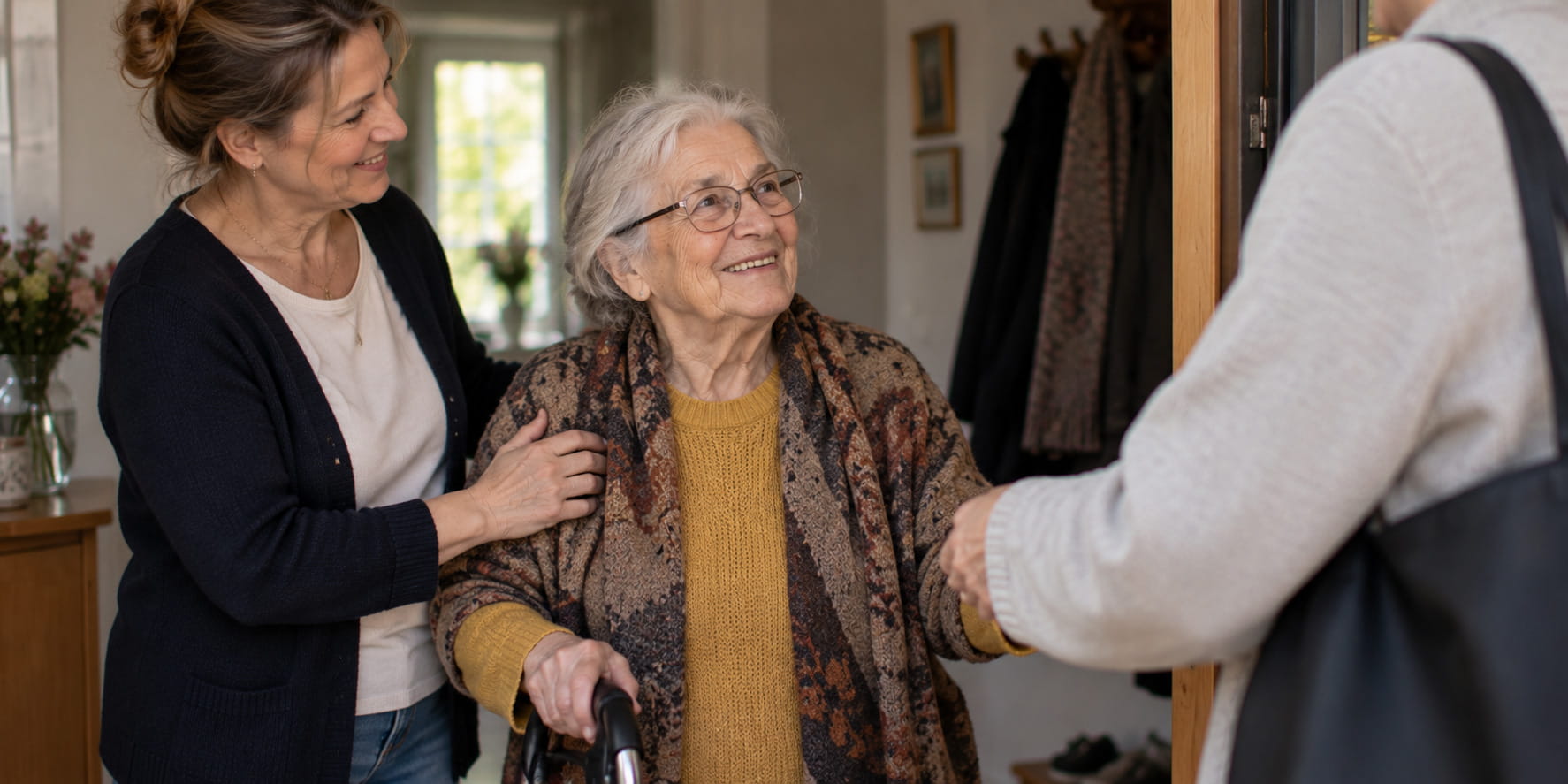
Small, regular help can often achieve more than rare, big breaks. Reliable cover does not mean giving up responsibility, but sharing it for a while.
How we work together
Initial conversation
The family's situation and the free time wanted are discussed together.
Clear agreement
A fixed schedule, tasks during the cover time and contact persons are agreed.
Start of the respite care
The agreed cover time begins and becomes a fixed part of everyday life.
Regular exchange
The scope is adjusted if the family's situation changes.
Want to talk about free time?
A first conversation clarifies which schedule really takes the pressure off.
Get in touchRespite for family carers does not replace medical treatment care or personal nursing care requiring professional qualifications. It complements existing support – for example from a nursing service – with the practical and personal side of everyday life.
Frequently asked questions
Questions about respite for family carers
That depends on available capacity and the desired schedule. After the initial conversation, it is usually quick to assess what is realistic in terms of timing and from when regular cover will be possible.
A single weekly cover slot can usually be found more quickly than for very extensive needs over several days – this is assessed openly in the initial conversation.
Yes. ElbFürsorge takes care of the practical and personal side of everyday life and combines well with the medical and nursing services of a nursing provider. Responsibilities are clearly defined in advance.
For example, medical care by the nursing service can be sensibly complemented by a fixed time with ElbFürsorge for conversation, walks or errands.
Since 1 July 2025, there has been a combined annual budget for respite care (Verhinderungspflege) and short-term care (Kurzzeitpflege). For 2026, it amounts to up to €3,539 per calendar year. Whether and in what form specific support can be funded this way depends on the legal requirements, the specific service and the provider.
This annual budget is separate from the monthly relief amount (Entlastungsbetrag) under § 45b SGB XI and can be used in addition if needed – the exact combination should be agreed with the long-term care insurance fund (Pflegekasse).
Fixed, reliable cover creates space for rest, hobbies or simply undisturbed time – often noticeably so after a short settling-in period.
Continuity is especially important for regular cover, so that trust can develop. Whether the same person will be available throughout is discussed in a personal conversation and depends on the agreed regularity.
If the regular contact person is on holiday or ill, we inform you in good time wherever possible and organise cover so that the agreed appointment does not have to be cancelled.
The long-term care insurance funds and the Hamburg care advice centres (Pflegestützpunkte) provide advice on care, support and funding – regardless of which insurer you are with. ElbFürsorge is happy to explain its own services, but cannot replace a binding decision by the Pflegekasse.
Especially when combining several benefits – such as the relief amount, respite care and a private agreement – a joint conversation with the Pflegekasse is worthwhile to avoid overlaps or gaps.
Under certain conditions, costs for cover can be claimed as household-related services under § 35a EStG (German Income Tax Act), provided they have not already been reimbursed by long-term care insurance. Double funding is not permitted.
If several relatives are involved in the care, the cover time can be planned to fit sensibly into the existing routine. Coordination between those involved helps to avoid overlaps.
A fixed cover time on certain weekdays can be scheduled to fit in with the family carer's working hours or appointments.
Even if family members live further away, the organisation on site can be taken care of. Regular updates keep them informed about the situation.
In the initial conversation, we openly discuss what actually takes the pressure off family carers in everyday life – this can range from fixed appointments to spontaneous free time.
Together we look at which weekday and time create the most free time in the family's everyday life – and this schedule can be developed further at any time if needed.
The agreed cover time can be paused if needed and resumed later, for example during a family holiday.
If care or support needs change, the scope of the respite care can be adjusted together.
Yes, how the time gained is used is entirely up to the family carer – whether for appointments, sport, friends or simply rest.
Respite care is not applied for in advance, but billed to the Pflegekasse with receipts after it has been used. The deadline for this is the end of the following year.
There is no fixed minimum duration; shorter cover times of one to two hours are also possible, provided this can be organised sensibly.
Continuity is particularly important for people with dementia. Wherever possible, a permanent caregiver is planned so that trust can develop.
A short update after each appointment can be agreed so that family carers stay informed without having to be there themselves.
An additional trusted person can mean welcome variety and new company for the person in need of care.
Want to talk about regular respite?
A first conversation clarifies which schedule really creates free time in everyday life.